Authors: Bárbara Paes and Ester Borges, Instituto Minas Programam. Originally published in GenderIT.org.
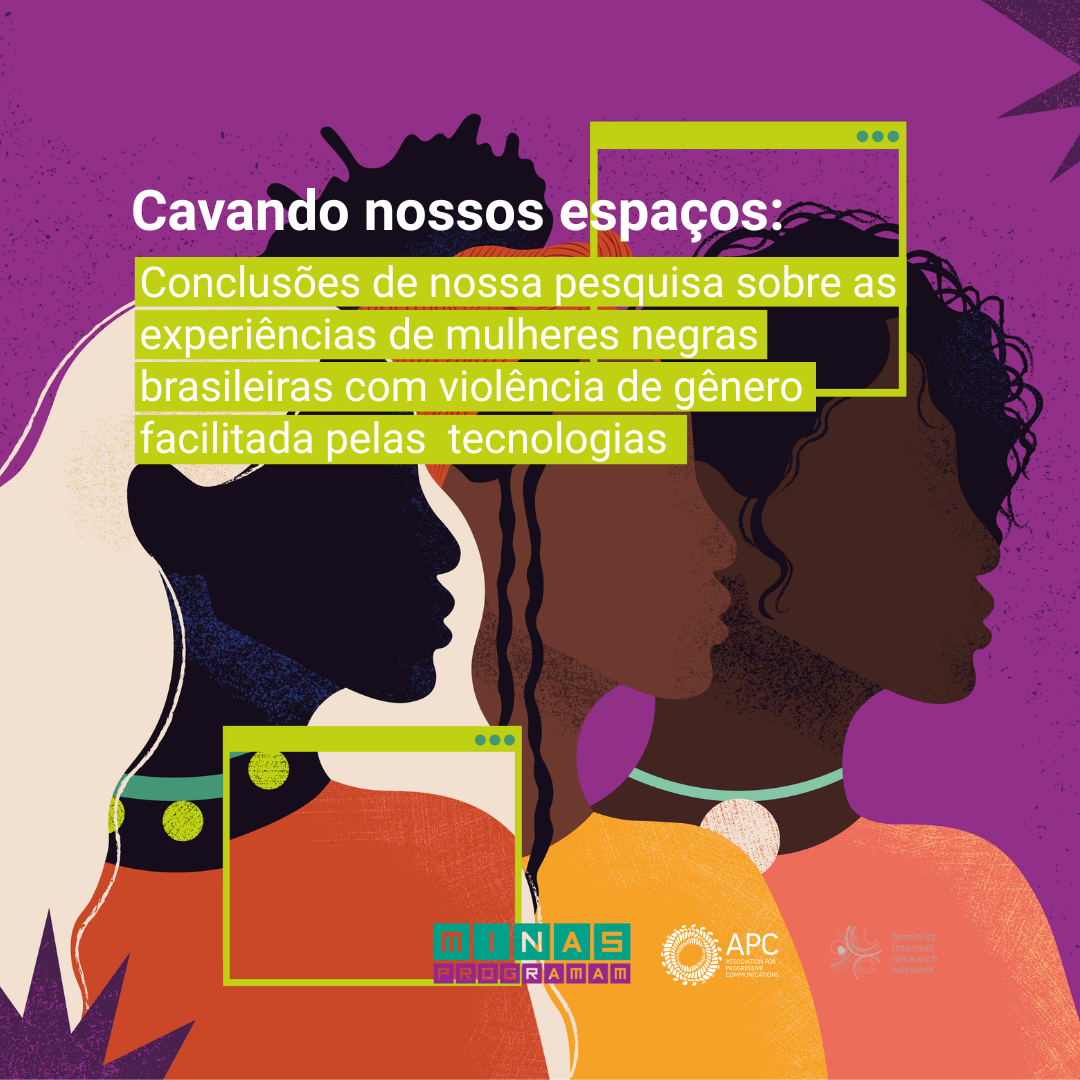
Illustration by Clarice Wenzel for Minas Programam and FIRN.
From April 2024 to March 2025, as part of the third iteration of the Feminist Internet Research Network (FIRN), Instituto Minas Programam carried out research about the impacts of technology-facilitated gender-based violence (TFGBV) on the experiences of Black Brazilian women.
Our findings show that despite mainstream digital technologies being often laden with racism, sexism and misogynoir,[1] Black Brazilian women have been carving out their/our own online spaces, building strategies for resistance, connection and possibility: using digital technologies for relationship-building and knowledge exchange, finding avenues for collective and self-expression and engagement with Black feminist discourse and activism, and influencing cultural and political agendas across the country.
In this article, we provide an overview of our research findings and highlight some of the key takeaways from our project.
Introduction: The research we were interested in building
The decade preceding this publication was marked by a growing, robust presence of Black Brazilian women organising and writing online through blogs, social media pages, online groups and networks. It was a time when Black Brazilian women successfully introduced new vocabularies to online publics, as well as disseminated Black feminist thought to broader audiences, reaching Brazil’s cultural and political agenda.[2] It is also when the organisation from which we write this research, Instituto Minas Programam, emerged as a space for knowledge production created by and for Black women and girls.
Simultaneously, it was a decade scarred by the occurrence of TFGBV and misogynoir against Black Brazilian women. Every so often, a few of these cases, especially when they involved well-known, high-profile individuals, would come to light. We have seen – sometimes up close, sometimes from further away – these incidents unfold with some frequency.
Our findings show that despite mainstream digital technologies being often laden with racism, sexism and misogynoir, Black Brazilian women have been carving out their/our own online spaces, building strategies for resistance, connection and possibility.
When we first started imagining what this research project would be, we were compelled to building a story about TFGBV and misogynoir in Brazil that took into account the stories of how Black women experienced these incidents: how these incidents impacted them, how women have elaborated, interpreted, analysed these phenomena and, crucially, what their experiences and reflections meant for their relationships with digital technologies.
To do so, we turned to conversations: Our methodology relies on qualitative data collection methods, including semi-structured interviews and group gatherings with 12 Black Brazilian women – writers, politicians, technologists, students, community organisers, artists and journalists – who have experienced some form of TFGBV and who are engaged with social justice organising, social movements, and political and/or digital activism.
This conversation started, in a way, before the research project itself. Our methodology includes a critical observation of participants’ online presence: a practice of intentional, contextualised study of participants’ online presence. This was made possible because, as researchers, we have had prior engagement and participation in different spaces of Black Brazilian women’s (digital and offline) organising to varying degrees over the years. Many of the blogs, online communities and publications described by research participants are places we, the researchers, have been following for years, where we have published our writing and/or engaged with discussions and events. Some of the examples cited during interviews are incidents that we had witnessed ourselves before beginning the research. We have known some of the interviewees and/or followed some of them throughout the past decade due to their online presence and digital activism.[3]
Our methodological choices were heavily informed by Black feminist thought, which has served both as an inspiration for research design and as the primary theoretical lens for data analysis, providing a framework that allows us to understand how race, gender, class and power shape the experiences of Black women on the internet. Throughout the project, we made an effort to recognise our positionality as researchers, respond to and welcome the ways research participants prompted us to strengthen our research approach, to adopt (imperfect) measures to navigate power dynamics embedded within the research process and to honour the research participants as the key contributors to this work.[4]
Where did our research (conversations) take us? A story of how Black Brazilian women are “carving out” our own spaces
We carved out this space for relationships and exchanges, really.[5]
In this quote, Flávia, who has had a long history of political activism, is referencing her engagement with feminist and Black feminist communities online in the early 2010s, and explaining something that resonated with many other interviewees: It was a time when nuanced conversations about issues that matter for Black Brazilian women were taking place online. This period was characterised by a growing presence of Black Brazilian women across social media and on the internet.[6] Blogs, social media pages, online groups and networks were emerging: Black Brazilian women were finding new channels for expression, ways to share their experiences, have fun and seek belonging.[7]
Black Brazilian women interviewed for this project acknowledged that commercial social media platforms and mainstream digital technologies are not designed for (and can often be hostile to) Black women.
Our research participants, too, had been using digital technologies to express their views, write about their experiences, denounce injustice, organise within social movements and advance their political projects. Flávia – along with other interviewees – pointed out that this was made possible by a practice of Black Brazilian women “carving out” the spaces to have conversations, negotiations, intellectual elaboration and political analysis. These spaces were not necessarily open or welcoming to Black Brazilian women’s discourse, organising and community.
Black Brazilian women interviewed for this project acknowledged that commercial social media platforms and mainstream digital technologies are not designed for (and can often be hostile to) Black women. At the same time, they reflected on the value of “carving out” their own spaces across the internet: spaces to share experiences, engage in discussions with other Black women, build connections and foster a sense of community. We found the notion of “carving out” reminiscent of the ideas of “finding chasms” articulated by scholar Knight Steele and “digital alchemy”, as described by Bailey.[8] Carving out: This metaphor gifted to us by this research participant is illustrative of the labour, care and time that go into creating, building and maintaining these spaces online, despite TFGBV and misogynoir.
In this research, we found that through “carving out” their/our own spaces online, Black Brazilian women have made room for relationship-building and knowledge exchange amongst each other, found avenues for collective and self-expression and engagement with Black feminist discourse and activism, and influenced cultural and political agendas across the country.
“Stirring up a hornet’s nest”: Looking to the impacts of TFGBV and misogynoir
Our report offers a closer look at how online spaces are embedded with racism, sexism and misogynoir in Brazil and how that impacts the experiences of Black Brazilian women online. We share stories of writers, activists and politicians whose public writing, organising and political engagement online have been met with attempts to delegitimise and intimidate via TFGBV, as well as those of Black women working in science and tech, who face attacks as they step into professional roles and/or digital spaces. The consequences of TFGBV and misogynoir included impacts to Black Brazilian women’s freedom of expression, leading to silencing, self-censoring and limitations of online behaviour; generated long-lasting psychological and emotional consequences; and, at times, became obstacles to women’s professional careers and engagement with activism.
Carving out: This metaphor gifted to us by this research participant is illustrative of the labour, care and time that go into creating, building and maintaining these spaces online, despite TFGBV and misogynoir.
Our findings reiterate the importance of analysing TFGBV and misogynoir against Black Brazilian women as phenomena that must be understood as continuations of broader violent expressions of racism, sexism and ableism prevalent in Brazilian society. We found that TFGBV against Black Brazilian women often seeks to reproduce and/or amplify narratives of Black Brazilian women being inadequate contributors to public debate about politics, culture, society, race relations, social issues in Brazil and/or not being fit to occupy certain professional positions in fields predominantly occupied by white (and often mostly male) Brazilians.
“No matter how simple what you’re going to say is, as a Black woman talking about tech, you’re going into a hornet’s nest,” explains Lúcia, a 39-year-old technologist who has suffered TFGBV.[9] The notion of the “hornet’s nest,” as Lucía skilfully described, reveals the hostility of online spaces in Brazil that many other research participants described to us; spaces where Black women are often seen as “invaders” or “outsiders” and subject to attacks frequently. Here, our findings resonate with research published by Trindade, who found that Black women between ages 20 and 35 and who have varying degrees of social mobility, represent 81% of victims of racist speech on social media in Brazil; and that the posts, “jokes” and attacks targeting them attempt at portraying Black women as “others”, whether as “invaders”; as “delinquent”; or as “uncultured” – especially when they access (or appear to be accessing) positions of relatively higher social status.[10]
As Trindade notes, users engaging in this practice are contributing to “the construction and dissemination of colonial-like racialized discourses against Black Brazilians on social media,” reinforcing their perpetuation in Brazilian society.[11]
These accounts reflect a broader systemic issue: the resistance to Black Brazilian women’s participation in certain elitist spaces and male-dominated fields. As Cida Bento points out through the concept of the “whiteness pact,” our presence in these spaces is often perceived as a territorial invasion, a threat to the established order.[12] When Black women dare to cross these invisible boundaries, we become preferential targets of hate speech that characterises us as “others” who do not belong in those environments.
No matter how simple what you’re going to say is, as a Black woman talking about tech, you’re going into a hornet’s nest.
– Lúcia, technologist
Our findings show that harmful stereotypes related to Black Brazilian women not belonging in spaces such as libraries, universities, politics, STEM professions and not being seen as valid intellectuals, knowledge creators and educators have often been invoked in instances of TFGBV. The various forms of TFGBV research participants faced have been permeated with narratives that attempt to portray them as unfit and/or unqualified for intellectual work, for certain professions, for positions in politics and for organising around social issues. We also found that when the content of their work made evident their intentions of bringing radical change to their communities, it also heavily influenced the attacks they suffered.
The aftermath of TFGBV and misogynoir: Critical reconsideration of engagement with digital technologies and digital care practices
We found that TFGBV and misogynoir impact participants’ lives and well-being, as well as their online behaviour. Some women changed how they posted or engaged in online spaces, some left online spaces they had been participating in and others became discouraged from continuing organising and/or pursuing their careers. While analysing these changes in online behaviour, our interpretation is that, while the silencing effect is an undeniable consequence of TFGBV, harming the freedom of expression of those who experience it, Black Brazilian women we interviewed have also engaged in a sort of refusal to be silenced entirely.
For example, Maria described that after suffering TFGBV and gendered political violence, she completely reshaped her online behaviour.[13] Though ultimately deciding against pursuing a public high-profile position as a political influencer and as an elected representative, she has continued to work in politics in other ways. She explains that she reconciles both the impact of her experience with TFGBV with her interest in using digital technologies in ways that she finds affirming:
“I’m still on social media, but sometimes a memory of those times hits me and I do everything [to decrease exposure]. After my past experiences, I have fear, I have removed potentially sensitive information from my social media accounts, and I no longer post [about my family or routine]. At the same time, as I removed all this information, I still check my accounts, I still post about politics and things I care about. I’m living with this duality, you know?”
This “duality” was echoed by many interviewees who described the aftermath of TFGBV incidents as moments of pause, as periods of critical reconsideration of how they want to engage with digital technologies moving forward. We found that Black Brazilian women who experience TFGBV navigate a complex set of repercussions. Interviewees go through an intentional process of decision-making about their engagement with digital technologies, informed by notions of digital care, balancing an awareness of how online spaces are permeated by misogynoir and a belief that they can still be valuable for their goals.
Many participants expressed that, in their perceptions, their experiences with TFGBV and online misogynoir are examples of how the design and development of many mainstream digital technologies reinforce, amplify and deepen forms of oppression such as racism, machismo, ageism and ableism.
From this, two important considerations emerge: The first relates to a recognition on the part of the research participants that digital technologies, including the platforms that dominate the internet today, are not designed in ways that are fair to Black women. Many participants expressed that, in their perceptions, their experiences with TFGBV and online misogynoir are examples of how the design and development of many mainstream digital technologies reinforce, amplify and deepen forms of oppression such as racism, machismo, ageism and ableism. We are reminded of how violence is not a glitch in the system: Racism, misogyny, ableism and classism embedded in our technologies are not malfunctions – they are design features.[14]
The second consideration we want to highlight concerns research participants’ desire to adopt digital care practices, to continue using these digital technologies in ways that preserve Black women’s “bodies and minds,” despite “technologies being hostile.”[15] Throughout the research project, several interviewees described making decisions over their use of digital technology to maintain their well-being, including changing privacy and adopting security measures; selecting social media platforms to prioritise, pondering where it would be strategic to maintain an online presence; moving to more “private” online spaces for organising; and reflecting about which kinds of content they post in which platforms.
“We’re together”: Our conversations wrap up with community, friendships, and hope
Letícia*, a 24-year-old university student, said, “I’ve realised more and more that Black women are the ones who can fully bear the brunt for other Black women. It’s Black women who hold each other and who say: “We’re together, negona,[16] you’re not alone, and let’s go.” We need to have more self-organised spaces, where we can debate, formulate, think. About us. By us. For us.”
A common thread across many of our interviews is that when Black Brazilian women face various forms of TFGBV, it is often in other Black women that they find the friendship, community and support they need.[17] In the aftermath of TFGBV, Black women cultivate friendship and community with each other. Letícia’s poignant declarations, “We’re together” and “You’re not alone,” serve as a reminder of the importance of self-organised spaces where Black women can convene, discuss, strategise and transform their realities.
In one of our gatherings with research participants, we asked those in attendance if they had any reflections or questions about the process more broadly. “I want to know: what happens after you publish this research?” asked Ana. “I think it should be a springboard for other things. It should be a starting point for more. More gatherings, more serious public debate about [TFGBV against Black Brazilian women].” Others agreed. The participants’ demand for more spaces for exchange and conversation between Black women impacted by TFGBV and misogynoir echoed throughout our research. Many point out that it is precisely through community and connecting with other Black women that it will be possible for those impacted by TFGBV and online misogynoir to combat some of the consequences in their lives and collectively organise.
In the aftermath of TFGBV, Black women cultivate friendship and community with each other.
As part of this research project, beyond deepening our understanding of how TFGBV and misogynoir impact Black Brazilian women, we wanted to explore what the hopes and demands Black Brazilian women have for digital technologies and the internet. A significant portion of our conversations with research participants during interviews and group gatherings was animated by questions related to what they wanted for digital technologies and the internet. “What would it look like to have digital technologies that resonate with what we want and with what we need?”, “What do we want out of digital technologies?”, “How can digital technologies be affirmative, instead of harmful?”.
Beyond analysing harm, participants also articulated what they want digital technologies and the internet to become. These are not simple questions to explore, and research participants had a lot to share. Here are some of the highlights, as interpreted by us: their visions coalesce around four interrelated demands: freedom of speech, access to knowledge, technologies made by and for Black women, and accountability.
- Freedom of expression for Black Brazilian women. TFGBV and online misogynoir were found to significantly affect the freedom of expression of Black Brazilian women. Research participants in this project indicated that guaranteeing Black women’s freedom of expression is a crucial element of a healthy Internet.
- Access to knowledge and information, and freedom of thought. Participants described that an affirmative internet for Black women would be a space where they can easily access diverse narratives about the lives of Black women, including knowledge and content generated by Black women. Our findings point to the importance of Black women (and other minority groups in Brazil) being able to access relevant information and knowledge that is useful to them in a free and accessible way. At the same time, in our conversations, participants very much emphasised the importance of having digital environments where information and content about Black women is not laden with racist, sexist, pejorative views. Finally, many participants expressed concern about the business models of the large commercial technology platforms that are widely used in Brazil.
- Digital technologies made by us and for us. Among the research participants, there is a recognition that digital technologies are not neutral and that the platforms that dominate the internet today are not designed in ways that are fair to Black women. Throughout the research project, participants frequently pointed out how the design and development of many of these technologies can, in many cases, reinforce phenomena such as racism, machismo and ableism. In light of this, there was a call for more spaces and conditions so that more Black women can continue to learn how to develop technologies, as well as question and challenge and oppose the social impacts of digital technologies that already exist. Secondly, there is also a perceived demand for digital technologies to be developed in ways that do not reproduce and amplify inequality, racism and misogyny.
As we wrap up this research project, we hope this work contributes to broader efforts to build a field of research and practice on TFGBV that is accountable to Black women’s lived experiences and political visions. We understand this work as part of a longer-term conversation that requires collaboration, listening and sustained engagement to imagine and create more just and safe digital futures. We invite those who read these stories to consider the ways in which Black Brazilian women, through their practices of survival, resistance and joy, are already building freer and more inclusive digital futures.
Footnotes
[1] Coined by Bailey and Trudy, the term refers to the ways in which racist and misogynistic representations in our culture and in digital spaces contribute to shaping society’s ideas and perceptions of Black women, creating an “inseparable fusion of toxicity.” See Bailey, M., & Trudy. (2018). On Misogynoir: Citation, Erasure, and Plagiarism. Feminist Media Studies, 18(4): 762–68. https://doi.org/10.1080/14680777.2018.1447395; Bailey, M. (2021). Misogynoir Transformed: Black Women’s Digital Resistance. NYU Press. https://www.jstor.org/stable/j.ctv27ftv0s
[2] Lima, D. C. (2024). #Conectadas: Feminismo Negro Nas Redes Sociais. Miraveja Editora. https://www.editoramireveja.com/product-page/conectadas
[3] Our positions as both researchers and, to some extent, members of the same groups as some of our participants offers us access to these artifacts as well as much of the rich context required to analyse them qualitatively. We are indebted to researchers such as Catherine Knight Steele and Dulci Lima who have brilliantly articulated similar approaches to critical analysis of digital Black feminism in their own work. See Steele, C. K. (2021). Digital Black Feminism. NYU Press. https://nyupress.org/9781479808380/digital-black-feminism; Lima, D. C. (2024). Op. cit.
[4] We wrote about our methodology in an earlier article. See Paes, B., & Borges, E. (2025, 28 April). “What happens after you publish this research?”: How feminist research invites us to centre liberation, connection and care in our practice. GenderIT.org. https://genderit.org/feminist-talk/what-happens-after-you-publish-research-how-feminist-research-invites-us-centre
[5] Flávia (fictitious name) is a 37-year-old activist. The names of all research participants have been altered for privacy, based on a collective decision made with participants, who expressed that anonymity conferred on them the ability to speak more freely about the issues they were facing or had faced, without risking potentially harmful personal exposure.
[6] Lima, D. C. (2024). Op. cit.
[7] Barros, T. N. (2021). Cited in Lima, D. C. (2024); Ribeiro, D. (2016, 10 December). A internet é o espaço que as mulheres negras encontraram para existir. El País. https://brasil.elpais.com/brasil/2016/12/09/politica/1481308817_062038.html; Dulci Lima states that: “Black feminist women, in this way, seem to rely on social media as a space for sharing and exchange, but also as an environment where they can exercise forms of participation in society’s political agendas.” Lima, D. C. (2024). Op. cit
[8] Steele, C. K. (2021). Op. cit.; Bailey, M. (2018). Op. cit.
[9] Lúcia (fictitious name) is a 39-year-old technologist.
[10] See Trindade, L. V. P. (2019). Discurso de Ódio Nas Redes Sociais. Editora Jandaíra; Trindade, L. V. P. (2018, 13 August). Social Media in Brazil: Distilling Racism Against Black Women. Social Science Space. https://www.socialsciencespace.com/2018/08/social-media-in-brazil-distilling-racism-against-black-women/
[11] Trindade, L. V. P. (2018). It is not that funny: a critical analysis of racial ideologies embedded in racialized humour discourses on social media in Brazil. Thesis for PhD in Sociology, University of Southampton.
[12] Bento, C. (2022). Op. cit.
[13] Maria (fictitious name) is a 30-year-old organiser.
[14] This perception is informed by thinkers such as Safiya Noble, Meredith Broussard, Ruha Benjamin, Moya Bailey and Catherine Knight Steele.
[15] We are indebted to the Transfeminist Digital Care Network (Rede Transfeminista de Cuidados Digitais) for the articulation of the concept of “digital care”: a way of approaching digital security from the perspective of everyday care, instead of the perspective of fear and securitisation.
[16] The word “nega”, and its variation “negona”, comes from the word “negra” and it is used in this context as a term of endearment, expressing love, familiarity and affection between the interlocutors.
[17] This common thread reminds us of Gonzalez’s concluding words in her essay “A mulher negra na sociedade brasileira”, in which she pays homage to the “anonymous Black women,” recognising them as the sustaining force which makes possible for Black women to organise. See: Gonzalez, L. (2020). A mulher negra na sociedade brasileira. In Por um feminismo afro-latino-americano. Zahar. https://mulherespaz.org.br/site/wp-content/uploads/2021/06/feminismo-afro-latino-americano.pdf